SwiftUI
NavigationStack Routing Basics
You've read thisNavigationStack works best when navigation is driven by data instead of ad-hoc view pushes.
enum Route: Hashable {
    case detail(id: UUID)
}
If routes are values, SwiftUI can keep navigation predictable.
More detail
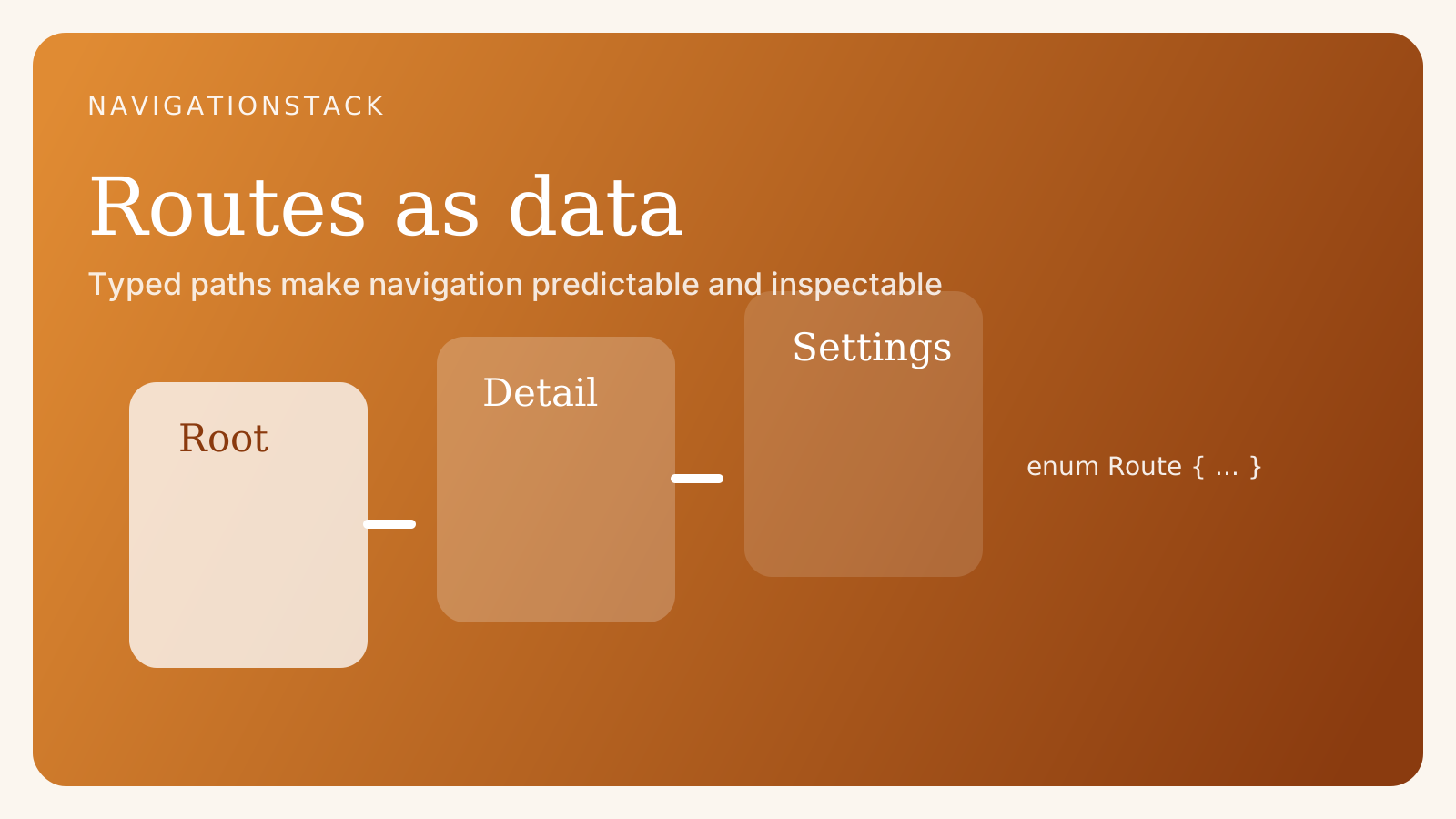
A common pattern is to store a path array in state and append routes into it. That gives you one place to understand where navigation comes from.
This improves several things:
- deep linking
- testing navigation behavior
- coordinating flows across screens
A compact route-driven flow looks like this:
flowchart TB
    A[User action or deep link] --> B[Create Route value]
    B --> C["path.append(route)"]
    C --> D[NavigationStack path]
    D --> E[navigationDestination resolves screen]
Routing as data gives you one ownership point for navigation and improves deep-link and test reliability.
The main benefit is not just cleaner code. It is clearer intent.
Once routes are modeled explicitly, features can talk about navigation in a shared language. Instead of toggling booleans or directly instantiating destination views all over the codebase, you describe where the app should go with a route value.
That usually leads to fewer incidental navigation bugs. Deep links are easier to support, back stacks are easier to inspect, and programmatic navigation becomes less ad hoc.
It also becomes easier to reason about ownership. The feature or coordinator holding the path is clearly responsible for the navigation state, instead of that state being spread across many local views.
Deep dive
When navigation is treated as data, it becomes composable. A route enum can express the destinations your feature supports without tightly coupling push logic to individual views.
That matters as apps grow. Navigation driven by scattered booleans and local button actions tends to become brittle. A typed route model creates a stronger contract between state, feature boundaries, and screen presentation.
This is why NavigationStack is more than a newer API. Used properly, it encourages a healthier architecture.
One reason this scales well is that navigation becomes serializable in spirit, even if not literally. A route path is a representation of app state, which means it can often be inspected, restored, tested, or reconstructed more easily than imperative push logic.
That has implications for deep linking, handoff, state restoration, and integration tests. A strongly modeled route path gives you something concrete to work with in all of those cases.
It also improves team communication. A route enum becomes a vocabulary for the feature. Instead of vague discussion about “going to the thing screen from over there,” the code and the people can talk in the same terms.
Another benefit is that presentation logic gets easier to centralize. Decisions about how routes map to screens can live in one predictable place instead of being scattered across buttons and callbacks.
So while NavigationStack can be used minimally, its real potential shows up when you embrace route values as part of the feature model itself. That is where it starts to feel architectural rather than merely visual.
Finished the deep dive?
You made it to the end.
Mark this bite as read once you have worked through the full piece. It is a small way to keep track of what you have genuinely finished.
More in this area
Keep the thread going.
Jump sideways into the related ideas that sit closest to this piece and keep the same mental context alive.