Swift
Actor Isolation Essentials
You've read thisActor isolation means the actor owns its state and outside code must go through the actor to access it.
struct Food: ~Copyable {
let emoji = "🍫"
}
eat(food)
print(food)
print(food)func greet() {
let name = "Adam"
let displayName = "Adam"
print("Hello \(name)")
print("Hello \(displayName)")
}actor SessionStore {
private var token: String?
func setToken(_ newToken: String) {
token = newToken
}
func currentToken() -> String? {
token
}
}The goal is simple: prevent multiple places from mutating the same state at the same time.
More detail
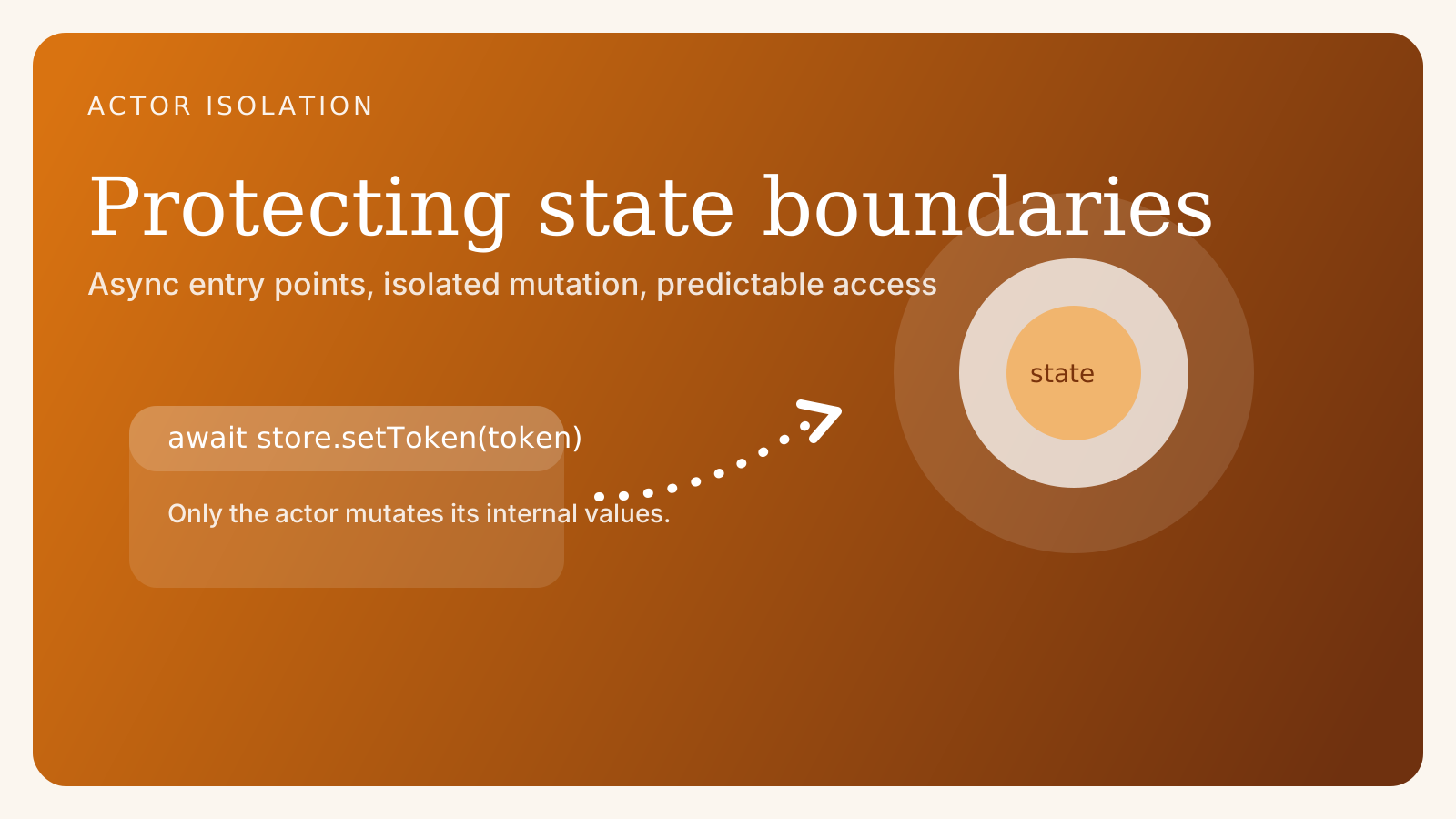
Actors help prevent data races in concurrent code. Instead of letting any task touch mutable state freely, Swift funnels access through actor-isolated methods and properties.
That is why calling into an actor often requires await. Crossing the boundary is explicit.
This changes the mental model of stateful services. A cache, session manager, or coordinator can become safer by giving ownership of its mutable state to an actor.
That explicitness is one of the biggest wins. Concurrency bugs often come from code that looks innocent because the boundary is invisible. Actors make the boundary impossible to ignore, which is exactly what you want when several tasks might be involved.
They also encourage you to narrow the surface area of mutable state. Once access becomes explicit, it becomes easier to spot which data truly needs protection and which parts of the system can remain plain immutable values.
This usually leads to better design. Services become clearer, coordination points become smaller, and the codebase gets a stronger sense of where concurrency-sensitive state actually lives.
Deep dive
Actor isolation is really an API design tool as much as a safety feature. Once a type is an actor, its boundary becomes part of how consumers think about it.
That forces good questions:
- what state should truly be isolated?
- which operations must be async?
- which values are safe to expose without breaking the boundary?
Treat actors as concurrency domains, not just thread-safe boxes. When their surface area is small and intentional, they tend to stay understandable and effective.
One common mistake is turning a large service into an actor without simplifying its interface. That can leave you with a type that is technically safe but still hard to reason about, because every interaction is now async and the responsibilities remain mixed together. Actor isolation works best when paired with good boundaries.
It is also worth remembering that actor isolation is not free. Crossing actor boundaries introduces suspension points, and suspension points affect control flow. That means API consumers need to think about ordering, cancellation, and when reentrancy might matter.
Reentrancy is where actors become more subtle. An actor can suspend while awaiting other work, and during that suspension it may process other messages. So while actors serialize access, they do not magically freeze all internal assumptions unless your code is written with suspension points in mind.
That is why treating actors as concurrency domains is more accurate than treating them as locks. They help structure who owns state and how work flows through that state, but they still reward careful design.
Once that mental model clicks, actors become much more powerful. They stop being just a safety feature and start becoming a way to organize asynchronous systems around explicit ownership and message flow.
Finished the deep dive?
You made it to the end.
Mark this bite as read once you have worked through the full piece. It is a small way to keep track of what you have genuinely finished.
More in this area
Keep the thread going.
Jump sideways into the related ideas that sit closest to this piece and keep the same mental context alive.